Street Photography from the World's Youngest Urbanist

Lulu Street Photography_40
Everybody sees their city differently. What does the city look like through the eyes of The World's Youngest Urbanist? Lulu-Sophia keeps delivering a solid flow of pure observations about city life. She also grows up in a home filled with cameras and has free access to all of them. What about putting those two things together, I thought.

Some Canon camera, be it 5 or 7D is usually lying in the window sill at our place. I often find photos on the memory card that Lulu-Sophia had taken of people out on the street in front of our flat. She just started picking up the camera and shooting. A couple of years ago I started handed her the camera when we're riding around on the Bullitt cargo bike.

I never say what she should take photos of. I just say "take photos if you want". Totally up to her and no big deal if she doesn't. Sometimes I don't notice what she does but when I load the photos onto the computer, I get to see what she sees. And it is quite wonderful.

I've made a little set of her street photography work on Flickr from when she was five but here are some of her shots from the urban landscape. Both from the flat and from the Bullitt.
Lulu Street Photography_38
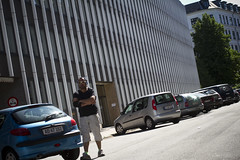
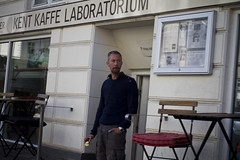
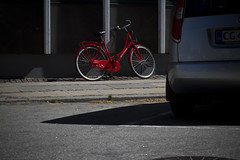
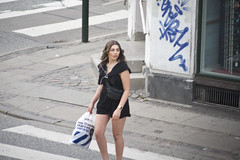
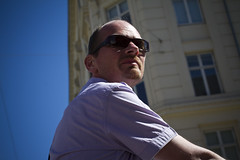
By and large, she photographs people. Still Life must be like watching paint dry for a five year old. Humans, please. Except, perhaps, for a pretty red bicycle (farther down) that caught her eye.

Lulu Street Photography_5 Lulu Street Photography_26

Lulu Street Photography_41 Lulu Street Photography (2)
People doing things. Transporting themselves, waiting for someone, observing - in their own way - their city. Humans watching humans.
Lulu Street Photography Lulu Street Photography_20

Lulu Street Photography_13 Lulu Street Photography_23

Lulu Street Photography_32

Lulu Street Photography_9 Lulu Street Photography_14

Lulu Street Photography_7 Lulu Street Photography_18
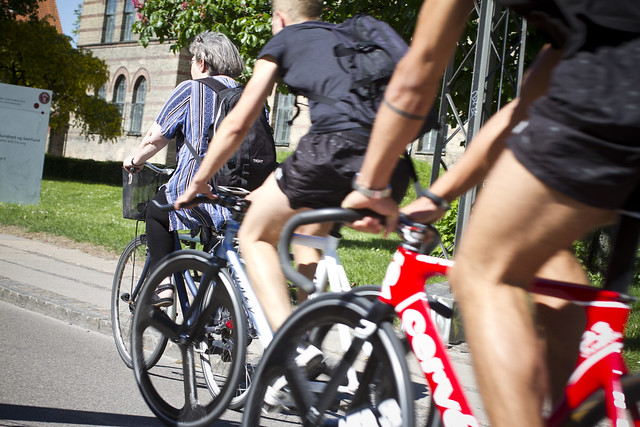
There are many bicycles, mostly because it's like shooting fish in a barrel in Copenhagen. You can't take a shot without a bicycle in it. When shooting from the flat, she shoots cyclists and pedestrians.
Lulu Street Photography_12

Lulu Street Photography_42 Lulu Street Photography_17

Lulu Street Photography_16

Lulu Street Photography_34 Lulu Street Photography_2

Lulu Street Photography_11
And of course, the set wouldn't be complete without a shot of your big brother, Felix.

Popular posts from this blog

7550 New Bike Parking Spots at Copenhagen Central Station

For all of Copenhagen's badassness as a bicycle city, there remains one thing that the City still completely sucks at. Bicycle parking at train stations. At Copenhagen Central Station there are only about 1000 bike parking spots. Danish State Railways can't even tell us how many spots they have. They're not sure. Even in Basel they have 800+. In Antwerp they have this . Don't even get me started on the Dutch. 12,500 bike parking spots are on the way in some place called Utrecht . Amsterdam has a multi-story bike parking facility, floating bicycle barges round the back and are planning 7000 more spots underwater . Even at the nation's busiest train station, Nørreport, the recent and fancy redesign failed miserably in providing parking that is adequate for the demand . Architects once again failing to respond to actual urban needs. It is time to remedy that. Here is my design for 7550 bike parking spots behind Copenhagen Central Station. Steve C. Montebello i...

The New Question for 21st Century Cities

It's all so simple if we want it to be. For almost a century we have been asking the same question in our cities. "How many cars can we move down a street?" It's time to change the question. If you ask "How many PEOPLE can we move down a street?", the answer becomes much more modern and visionary. And simple. Oh, and cheaper. Let alone the fact that the model at the top can move 10 times more people down a street than the model at the bottom. When I travel with my Bicycle Urbanism by Design keynote , I often step on the toes of traffic engineers all around the world. Not all of them, however. I am always approached by engineers who are grateful that someone is questioning the unchanged nature of traffic engineering and the unmerited emphasis placed on it. I find it brilliant that individual traffic engineers in six different nations have all said the same thing to me: "We're problem solvers. But we're only ever asked to solve the sam...

The Race for Lithium for Electric Cars and Bicycles

Uyuni Salt Flats, Bolivia. Photo: Ezequiel Cabrera/Wikipedia The coming boom in batteries to electric cars and Lazy Bikes (electric-assist bicycles) means a boom in batteries with which to run them. A new race for natural resources has begun. Enter Lithium, the world's lightest metal. For 150 years it's been nickel and lead that have been used in batteries but the advent of lithium technology has allowed for a revolution. Longer battery life, lighter batteries in our laptaps and mobile phones and iPods. Lithium weighs 1/20th of what nickel and lead do. Lithium is also used in anti-depressive medicine, ceramics and nuclear power. With all this talk of electric cars and bicycles, the demand for lithium is on the verge of exploding. Lithium is the new oil. Enter Boliva. This developing country sits on at least half of the world's supply of lithium, most of it in underground salt layers beneath the world's largest salt flats in Salar de Uyuni , in south-west Boliva. Betwee...